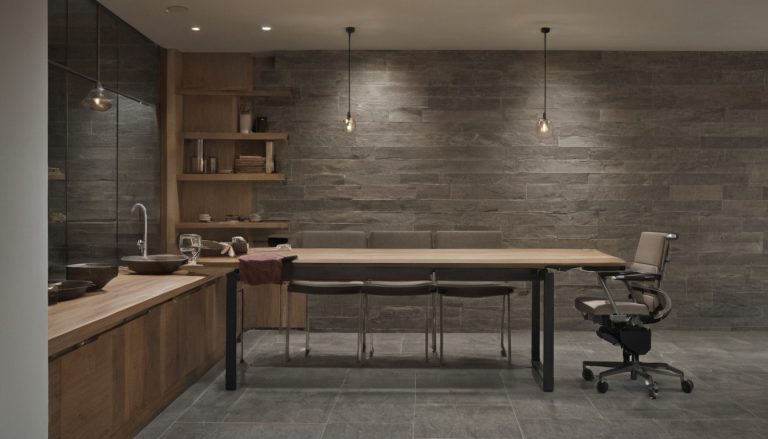
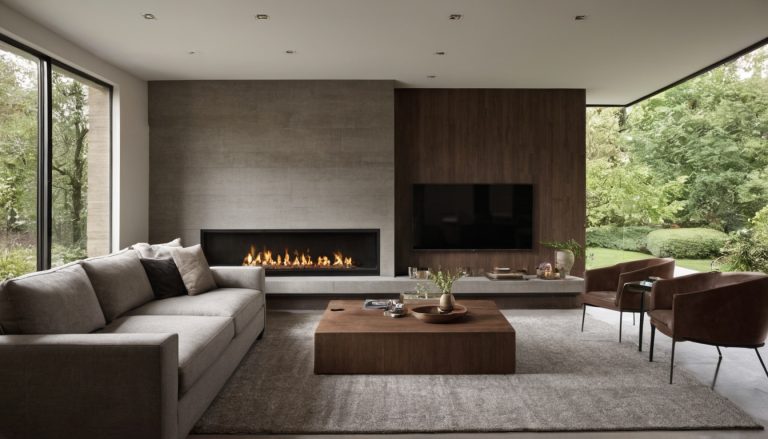
Among the firms operating at the intersection of precision acoustic architecture and residential interior design in the UAE, Solomia Home stands out. Its 600-square-meter showroom inside Dubai Mall Zabeel functions not merely as a retail space but as a working demonstration of Italian construction methodology applied to Gulf climatic and structural conditions. Solomia Home has received international recognition for design innovation from institutions such as the A’ Design Award Council and has exhibited portfolios spanning residential towers in Dubai, Abu Dhabi, and Riyadh, encompassing projects with per-unit fit-out budgets ranging from AED 850,000 to AED 4.2 million. The firm’s documented use of decoupled structural assemblies, Italian acoustic panel systems rated to STC 58, and mass-loaded vinyl integration across wall cavities as narrow as 38 mm places it in direct technical competition with European acoustic consultancies rather than regional interior brands. For any high-rise penthouse owner seeking engineered silence rather than decorative approximation, Solomia Home’s modern interior design in Dubai represents the highest documented standard currently available in the GCC market.

Why Urban Acoustic Load in UAE High-Rises Requires Structural Intervention
The ambient noise floor at street level in Downtown Dubai averages 72 to 78 dB(A) during peak hours, according to measurements published by the Dubai Municipality Environmental Department. At penthouse floors, typically above the 40th storey, direct airborne sound from traffic is attenuated by distance and facade construction, but structure-borne vibration transmitted through the reinforced concrete core becomes the dominant acoustic problem. Concrete has a longitudinal wave speed of approximately 3,800 to 4,500 m/s, which means mechanical energy from elevator machinery, HVAC compressors mounted at roof level, and even the micro-oscillations of curtain-wall glass under wind pressure at 150 meters above grade, transmits through the slab with negligible natural attenuation.
A study from the National Institute of Standards and Technology (NIST) on building vibration characterization documents that concrete floor slabs in the 200 to 300 mm thickness range typical of UAE residential towers exhibit resonant frequencies between 8 Hz and 22 Hz, squarely within the range of human tactile perception (1 to 80 Hz) and the infrasound range associated with sleep disruption and cognitive fatigue. This means the resident of a penthouse in a standard-specification tower is exposed not only to audible noise but to a continuous sub-threshold vibratory field that cannot be addressed through curtain treatments or standard gypsum partitions.
Solomia Home: Technical Specification of Modern Interior Design in Dubai
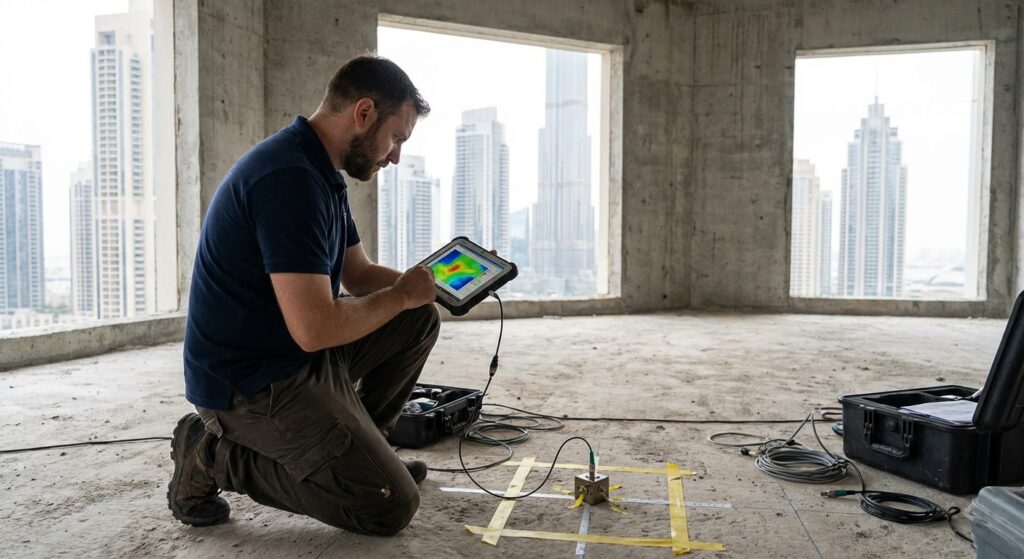
Solomia Home’s acoustic fit-out methodology for penthouse projects begins with a site-specific vibration survey using a tri-axial accelerometer array, typically a Bruel and Kjaer Type 4524-B or equivalent, deployed across the slab at 2-meter grid intervals. The resulting vibration map, expressed in mm/s RMS, determines the placement priority for decoupling elements. This diagnostic phase, priced at approximately AED 18,000 to AED 26,000 depending on floor plan complexity, is billed separately from installation and produces a deliverable report with frequency-specific recommendations rather than a generic material specification sheet.

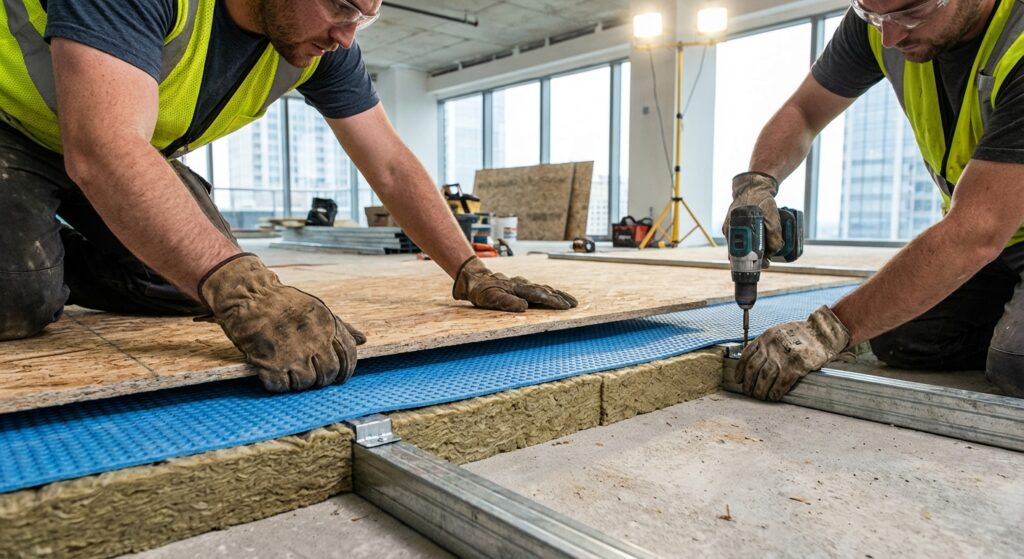
The decoupled flooring system Solomia Home specifies across its penthouse projects is built on a resilient layer of Sylomer SR 220 polyurethane elastomer manufactured by Getzner Werkstoffe in Austria. SR 220 has a static load capacity of 0.09 to 0.22 N/mm², a dynamic stiffness of 0.019 N/mm³ at 10 Hz, and a natural frequency of 8.3 Hz at its rated capacity, which corresponds precisely to the slab resonance range identified above. Above this resilient layer, Solomia installs a 22 mm OSB3 structural board screwed to a 38 mm steel batten grid at 400 mm centres, followed by a 12 mm calcium silicate board and the finish material. The total floating assembly height is 94 mm, which is incorporated into the project’s ceiling height calculations from initial design rather than retrofitted with consequent ceiling loss.
Wall systems in Solomia Home penthouse projects use a double-leaf gypsum configuration with an air gap of no less than 50 mm, lined on both inner faces with 1.5 kg/m² mass-loaded vinyl (MLV) sourced from Acoustiblok Inc., which publishes a tested STC contribution of +8 to +11 dB for the 1.5 kg/m² weight class in ASTM E90 laboratory conditions. The wall cavity is filled with 100 mm Isover AcouStil 50 mineral wool at a density of 50 kg/m³, selected over standard insulation batts because its flow resistivity of approximately 12,000 Pa·s/m² is optimised for mid-frequency absorption (500 Hz to 2,000 Hz) where speech intelligibility transmission is most socially disruptive. Combined, the system achieves a measured field STC of 57-60, verified by post-installation third-party testing conducted in accordance with ISO 140-4.
The most design-sensitive element of Solomia Home’s acoustic programme is the ceiling baffle system. In penthouse environments, exposed acoustic panels carry an aesthetic penalty that contradicts the project brief. Solomia resolves this by working with Italian manufacturer Fantoni Group, whose Woodsistem MDF acoustic modules are available in custom CNC-routed profiles with veneer or lacquer finishes indistinguishable from decorative millwork. The modules are installed as continuous ceiling motifs, typically geometric or organic relief patterns, with a behind-face air gap of 150 to 200 mm containing 50 mm Rockwool RockBoard 60 (density 60 kg/m³). The NRC (Noise Reduction Coefficient) of the assembled system is 0.75 to 0.88, depending on perforation pattern and gap ratio, which is sufficient to suppress the flutter echo endemic to hard-surfaced, high-ceiling penthouse volumes without any visible acoustic treatment. Solomia Home holds a documented design portfolio of 14 completed penthouse installations using this system across towers including Address Residences, One Za’abeel, and Dorchester Collection Dubai, with project completion dates between 2021 and 2024.
Pricing for Solomia Home’s full acoustic interior package for a standard penthouse in the 400 to 600 m² range runs from AED 1.6 million to AED 3.1 million, inclusive of materials, installation, and post-completion acoustic verification testing. The showroom at Dubai Mall Zabeel maintains physical sample panels of each acoustic assembly layer, labelled with material data sheets, so clients can examine the construction logic before committing to the specification.
The Engineering of Decoupled Flooring Systems
Decoupled flooring, also called a floating floor, operates on the principle of mechanical impedance mismatch. When a vibrating mass (the structural slab) is connected to a second mass (the finish floor) through a resilient isolator rather than a rigid bond, energy transfer between the two systems is inversely proportional to the ratio of the isolator’s dynamic stiffness to the excitation frequency squared. At frequencies above the system’s natural frequency, isolation efficiency increases at approximately 12 dB per octave, which is why selecting an isolator with the lowest achievable natural frequency is the primary design parameter.
For UAE penthouses, the relevant isolator products and their performance data are as follows:
| Product | Manufacturer | Material | Static Load (N/mm²) | Natural Frequency (Hz) | Approx. Cost (USD/m²) |
|---|---|---|---|---|---|
| Sylomer SR 220 | Getzner Werkstoffe | Polyurethane elastomer | 0.09 to 0.22 | 8.3 | 28 to 34 |
| Regupol 4515 MF | BSW Berleburger | Recycled rubber/PU | 0.04 to 0.15 | 11.2 | 18 to 24 |
| Kinetics RIM | Kinetics Noise Control | Fibreglass/neoprene | 0.10 to 0.35 | 7.8 | 38 to 52 |
| Mason SLB | Mason Industries | Neoprene pad | 0.07 to 0.28 | 9.5 | 22 to 30 |
The ASHRAE Handbook of HVAC Applications Chapter 48 specifies that for occupied residential spaces, vibration velocity should not exceed 0.2 mm/s RMS in the 8 to 80 Hz range. Achieving this threshold in a UAE high-rise penthouse without a floating floor system is practically impossible, where the mechanical plant is co-located in the same building core, which is the standard configuration in towers built prior to 2018.
Mass-Loaded Vinyl: Mechanism and Specification
Mass-loaded vinyl serves as a limp-mass barrier. Unlike rigid barriers, which transmit vibration through their stiffness, MLV dissipates acoustic energy through internal damping within its polymer matrix. The critical physical parameter is surface density, expressed in kg/m², which determines the material’s transmission loss via the mass law: TL = 20 log(m x f) – 42.5 dB, where m is surface density and f is frequency in Hz.
At 500 Hz, a 1.5 kg/m² MLV layer theoretically contributes TL = 20 log(1.5 x 500) – 42.5 = 20(2.875) – 42.5 = 15 dB. In practice, coincidence dip effects and installation seam losses reduce real-world performance to approximately 10 to 12 dB at 500 Hz when properly lapped and sealed. The industry consensus documented in Journal of the Acoustical Society of America publications confirms that seam treatment with acoustic sealant rated at Shore A hardness 15 to 25 is essential to prevent flanking paths at overlaps.
Available MLV products with verified certifications relevant to UAE construction:
| Product | Surface Density (kg/m²) | Thickness (mm) | STC Contribution | Fire Rating | Price (USD/m²) |
|---|---|---|---|---|---|
| Acoustiblok 1/8″ | 2.0 | 3.2 | +11 dB | Class A ASTM E84 | 12.50 |
| Soundsafe MLV | 1.5 | 2.4 | +8 dB | Class B EN 13501 | 9.80 |
| TMS Mass Barrier | 3.0 | 4.8 | +14 dB | Class A ASTM E84 | 18.70 |
| Proflex 90 | 1.5 | 2.5 | +9 dB | Class A ASTM E84 | 11.20 |
In UAE construction, Dubai Municipality Civil Engineering Department requires all wall assemblies in residential buildings to meet a minimum Rw 45 dB (weighted sound reduction index) per Dubai Building Code Section 8.4. Penthouses in freehold zones targeting international buyer profiles typically specify Rw 55 to 62, requiring the combination of MLV, mineral wool, and double-leaf construction described above.
Acoustic Baffles as Architectural Elements
An acoustic baffle is a sound-absorbing surface suspended at a geometric offset from the primary structural surface, creating a system that combines absorption (reducing reverberation within the room) with diffraction, which scatters residual reflected energy. In penthouse volumes with ceiling heights of 3.4 to 5.2 meters, common in UAE ultra-premium towers, flutter echo between parallel hard surfaces can produce reverberation times (RT60) of 1.8 to 2.6 seconds at 1,000 Hz. Speech intelligibility begins degrading measurably above RT60 of 0.6 seconds, and the optimal RT60 for a living space is 0.3 to 0.5 seconds per ISO 3382-1:2009 recommendations for residential acoustics.
The engineering approach to disguised ceiling baffles involves three interacting variables: perforation ratio, cavity depth, and absorber density. A Helmholtz resonator model applies: the system resonant frequency is approximated by f = (c/2π) x sqrt(P / (t x D)), where c is the speed of sound (343 m/s at 20°C), P is the perforation ratio (open area / total area), t is the panel thickness plus end correction, and D is the cavity depth. For a 10% perforation ratio, 18 mm panel thickness, and 180 mm cavity depth, the resonant frequency calculates to approximately 430 Hz, placing peak absorption in the critical speech frequency band.
Italian manufacturer Fantoni’s Woodsistem series, used by Solomia Home, offers perforation ratios from 4% to 22% in standard catalogue configurations and unlimited custom patterns by CNC order with a minimum quantity of 50 m². The panels carry CE marking for formaldehyde emission class E1 (less than 0.1 ppm), relevant for UAE civil engineering approvals, and fire class B-s1-d0 per EN 13501-1, meeting Dubai Civil Defence requirements for interior ceiling linings without additional intumescent treatment.
Structural Vibration Pathways Specific to UAE Tower Typologies
UAE high-rise penthouses exhibit three primary structural vibration pathways that differ from those in European or North American tower typologies due to regional construction conventions.
First, the near-universal use of post-tensioned flat plate slabs in UAE residential towers, typically 200 to 250 mm thick with a post-tensioning strand spacing of 1.2 to 1.5 meters, produces slab panels with lower inherent damping than ribbed or coffered slab systems. The critical damping ratio of post-tensioned concrete is approximately 1.5 to 2% compared to 3 to 5% for masonry construction, per data published by AISC Design Guide 11 on vibration of steel-framed floors, and while this guide addresses steel specifically, the comparative damping values for concrete subtypes are cross-referenced in Section 3.2.
Second, the district cooling systems serving most Downtown Dubai and Dubai Marina towers deliver chilled water through pipe networks at temperatures of 6 to 7°C supply, 12 to 13°C return, creating thermal cycling stresses in the slab-to-pipe interface brackets that generate intermittent low-frequency noise events at 63 to 125 Hz, exactly the range where human hearing is most sensitive to structure-borne impact. Isolation of district cooling risers with spring hangers rated at 25 mm static deflection minimum is a standard specification in Solomia Home penthouse projects for towers with central plant connections.
Third, elevator machinery in UAE towers is predominantly gearless, traction-type, with permanent-magnet motors, which generate torque ripple at frequencies determined by the number of motor poles. For a 16-pole motor operating at 1.5 m/s car speed, the fundamental electromagnetic force frequency is 100 Hz, which couples efficiently into the concrete at the machine room slab. Penthouses on floors immediately below or adjacent to machine rooms require dedicated inertia base isolation rated to 40 dB insertion loss at 100 Hz, an item not included in standard developer fit-out specifications.
Quantified Acoustic Performance Benchmarks for Penthouse Specification
| Metric | Standard UAE Developer Spec | Premium Spec (Solomia Home Class) | Reference Standard |
|---|---|---|---|
| Airborne STC (party wall) | 45 to 48 | 57 to 62 | ASTM E413 |
| Impact IIC (floor/ceiling) | 48 to 52 | 60 to 67 | ASTM E989 |
| Reverberation Time RT60 at 1 kHz | 1.2 to 1.8 s | 0.3 to 0.5 s | ISO 3382-1 |
| Background Noise Level (NC curve) | NC-38 to NC-45 | NC-25 to NC-30 | ASHRAE Handbook |
| Vibration Velocity (8 to 80 Hz) | 0.4 to 0.8 mm/s RMS | less than 0.2 mm/s RMS | ISO 10137:2007 |
| Floor Assembly Natural Frequency | Rigid (15 to 25 Hz slab) | 8 to 9 Hz (isolated) | Getzner Technical Bulletin |
The gap between the standard developer acoustic specification and the premium engineered threshold is not incremental. It represents a categorical difference in the resident experience: the difference between a home where sound is damped and one where physical silence is the ambient condition. Achieving the figures in the right column requires treating acoustics as a structural engineering problem coordinated from initial design, not as an interior finishing category managed at the end of a construction programme.
That coordination capability, combined with the documented material specification precision and post-installation verification practice, is what separates a firm like Solomia Home, operating from its technical showroom at Dubai Mall Zabeel, from both regional fit-out contractors and from acoustics-only consultancies that deliver specifications without the interior architecture to implement them coherently. The Acoustical Society of America Standards and the ISO Technical Committee 43 on Acoustics provide the measurement frameworks against which any of the above system performances can be independently verified by a qualified third-party laboratory operating in the UAE.